Recursos Principais e Garantia de Privacidade
- ✓ Execução 100% no Navegador: Seus dados nunca saem do seu dispositivo nem tocam servidores remotos.
- ✓ Saída Instantânea em Tempo Real: Zero latência de rede, cálculo ao digitar e cópia rápida.
- ✓ Gratuito e Ilimitado para Sempre: Sem cadastro, sem planos pagos e sem limites de uso.
- ✓ Em Conformidade com Padrões: Construído estritamente segundo padrões web RFC, ISO e W3C.
Encode text, numbers, and IDs to Base62 online
Convert alphanumeric strings, integer database keys, or binary hashes into compact, URL-safe Base62 format using the standard 62-character alphabet (0-9, A-Z, a-z).
Especificações Técnicas e Arquitetura
- Technical Standard:
- Base62 URL-Safe Radix-62 Encoding Standard
- Execution Environment:
- 100% Client-Side Browser Sandbox
- Data Privacy:
- Zero Server Storage / No Tracking
- Processing Speed:
- Real-time local CPU execution
- Cross-Platform:
- Works on Windows, macOS, Linux, iOS & Android
Character Set & Binary Radix Transformation
Encoders and decoders map binary byte sequences or text characters to alternative radix representations (such as Base64, Base62, Hexadecimal, or URL Percent-Encoding). Decoding performs the inverse mathematical mapping to restore the original plain text or binary buffer. Because processing occurs entirely within local browser memory, API keys, sensitive tokens, and session credentials never leave your machine.
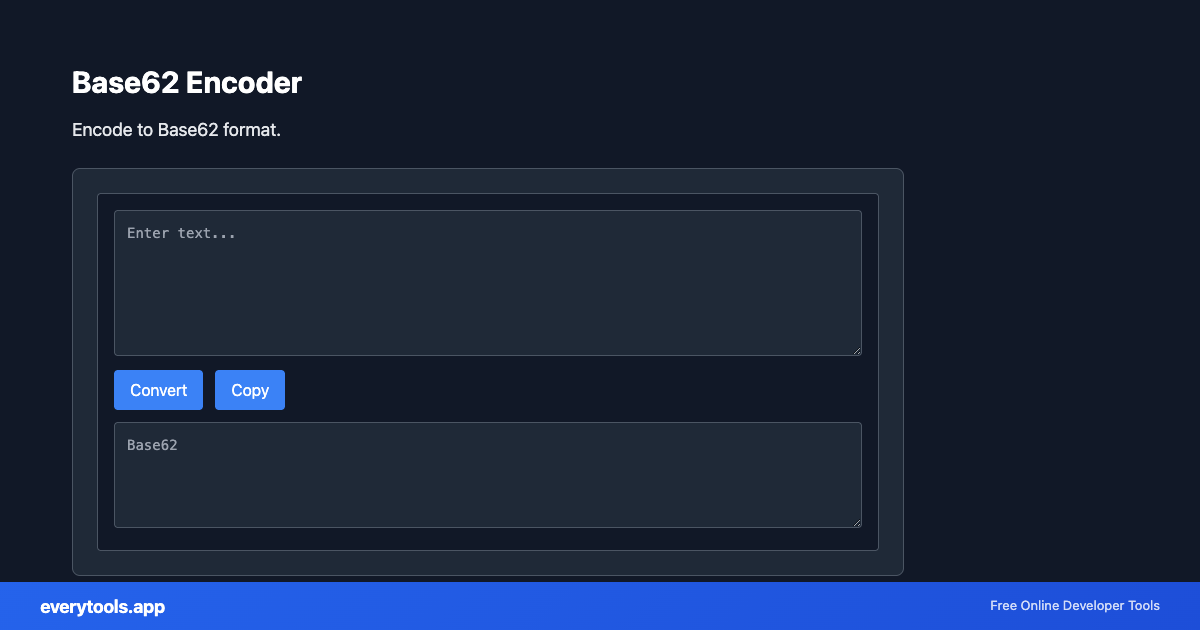
Provide Input
Enter, paste, or upload your data into the input field above.
Configure & Process
The tool immediately processes your input in real time according to your chosen settings.
Copy or Save
Use the Copy button to copy the output to your clipboard, or download the result to your device.
Referência Técnica e Padrões
Base62 vs Base64: Why Base62 is Superior for URLs
While Base64 uses 64 characters including plus (+), slash (/), and equals (=) for padding, Base62 is strictly restricted to digits and alphanumeric characters (0-9, a-z, A-Z). This makes Base62 completely URL-safe without requiring percent-encoding (%2B, %2F) in query parameters or routing path segments, preventing character corruption when links are shared in chat apps or emails.
URL Shortener & Database Snowflake ID Architecture
Modern distributed architectures (such as Twitter Snowflake, Instagram ID sharding, and URL shortening services like Bitly) use Base62 to compress large 64-bit integers into 6-to-8 character strings. For example, a 64-bit integer ID like 125,304,207,784 converts to an ultra-compact Base62 slug '4K6wXf', reducing storage overhead and creating memorable short links.
Casos de Uso Comuns
- Generate short URL slugs from numeric database IDs
- Create URL-safe API keys and session tokens
- Encode file or asset IDs for CDN paths without special characters
- Compact encoding for Bitcoin-style addresses and identifiers
Saiba Mais
Guias e dicas
Você também pode gostar
Ferramentas Conectadas e Próximos Passos
Utilitários recomendados frequentemente utilizados com Base62 Encoder
Base64 Encoder
Encode text or binary to Base64.
URL Slug Generator
Convert text to URL-friendly slugs. Create SEO-friendly URLs from titles.
Random UUID Generator
Generate RFC 4122 compliant UUIDs (v4) for unique identifiers.
Outras Codificadores e Decodificadores
URL Decoder
Decode URL-encoded strings. Convert percent-encoded text to readable form.
URL Encoder
Encode text for URLs. Convert special characters to percent-encoding.
Base32 Encoder
Encode text to Base32 format.
Base32 Decoder
Decode Base32 encoded strings.
Base64 Encoder
Encode text or binary to Base64.
Base64 Decoder
Decode Base64 encoded strings.
HTML Decoder
Decode HTML entities to plain text.
HTML Encoder
Encode special characters to HTML entities.
Perguntas Frequentes
- What is Base62?
- Base62 is an encoding scheme using 62 characters: 0-9, A-Z, a-z. It creates shorter strings than Base64 and is URL-safe since it avoids +, /, and = which need encoding in URLs.
- Base62 vs Base64?
- Base64 uses 64 characters and often adds padding. Base62 uses 62 and needs no padding. Base62 is better for URLs and short identifiers. Base64 is more common for binary data in JSON or MIME.
- When to use Base62?
- Use Base62 for short URLs, database IDs, API keys, or any identifier that should be compact and URL-safe. It's popular in systems like URL shorteners and Bitcoin addresses.